

English
Initial setup
Three steps done once only, before the first run. After this, the monthly routine is far lighter.
Step 1 — Payroll Settings
The figures are pre-filled according to prevailing regulation, so usually you only need to check them and fill in one thing.
What the page holds:
- Health insurance — the company and employee percentages, with their caps
- Employment insurance — old-age, pension, accident, and death benefits
- Income tax — occupational allowance, the surcharge for those without a tax number, the tax year
- Validation — minimum wage, deduction limits, salary-change warning thresholds
Figures are written in basis points
400 means 4.00%; 5000 means 50%.
This lets fractional percentages such as 3.7% be written exactly (370) without rounding. Entering 4 where 400 is expected produces a contribution one hundredth of what it should be.
The one thing you must fill in yourself: minimum wage
Enter the figure for your company's region. Left at zero, the minimum wage check does not run at all — and pay below the regional minimum will pass without a warning.
Tax rate tables are not on this page, and that is deliberate: they are national constants. When national rates change, they are updated through an application update rather than retyped by each company.
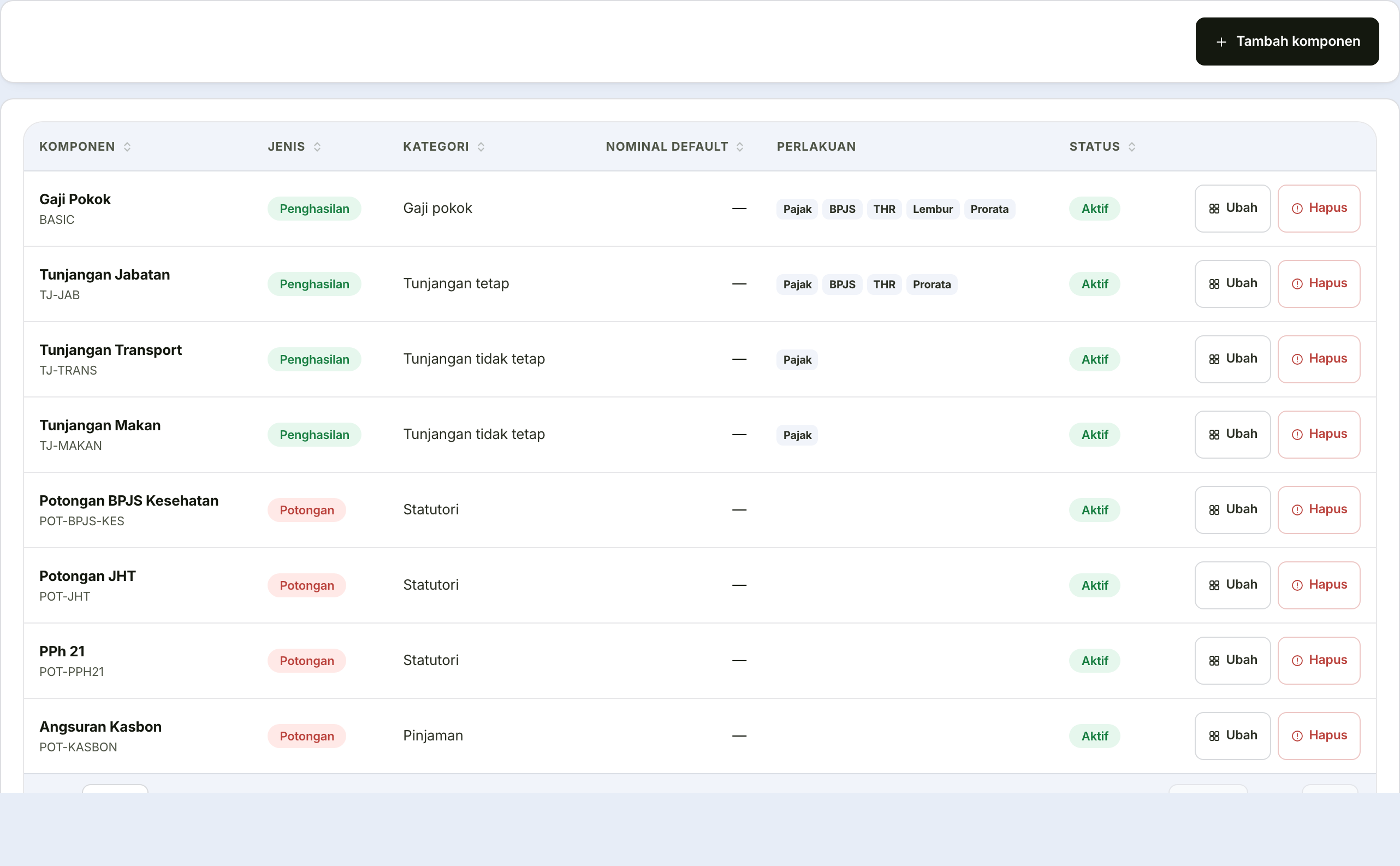
Step 2 — Salary Components
Build the catalogue of components your company uses.
| Column | Explanation |
|---|---|
| Code | A short identifier, appearing in reports |
| Name | What the employee sees on the payslip, for instance "Basic Salary" |
| Type | Earning (adds) or deduction (subtracts) |
| Category | Basic salary, fixed allowance, variable allowance, and so on |
| Payslip order | Lower numbers appear first |
| Default amount | May be zero — per-person amounts are set in step 3 |
| Treatment switches | Six switches deciding tax, social security, festive allowance, and overtime treatment |
A typical arrangement
| Component | Taxable | Social security base | Festive base | Overtime wage | Fixed allowance | Prorated |
|---|---|---|---|---|---|---|
| Basic Salary | ✅ | ✅ | ✅ | ✅ | ❌ | ✅ |
| Position Allowance | ✅ | ✅ | ✅ | ✅ | ✅ | ✅ |
| Daily Transport Allowance | ✅ | ❌ | ❌ | ❌ | ❌ | ✅ |
| Daily Meal Allowance | ✅ | ❌ | ❌ | ❌ | ❌ | ✅ |
Notice the pattern
Allowances paid per day of attendance usually do not count toward the social security, festive allowance, or overtime bases — because their amount is not fixed.
If you are unsure about a component, ask: "if this person takes two weeks' leave this month, does this component stay whole?" If not, it probably does not belong in those bases.
Changing or deleting a component always asks for confirmation, because the effect reaches every employee using it.
Step 3 — Employee Payroll Data
Search for the employee and click their row. There are two sections.
A. This person's salary components
Add components from the catalogue, enter the monthly amount for that person, and the effective from date.
B. This person's tax and social security profile
| Column | Explanation |
|---|---|
| Dependant status | Determines their tax rate — marital status and number of dependants |
| Tax method | Gross, gross-up, or net |
| Has a tax number | Without one, the tax is higher as required by regulation |
| Social security programmes | Tick the programmes they are enrolled in |
| Contribution base | Actual salary, regional minimum wage, or a specific amount |
| Accident risk class | According to the nature of the work |
| Family members | Affects the health premium |
| Bank account | For payment |
| Eligible for overtime / festive allowance | Switch off for exempt positions |
| Proration basis | Calendar days or working days |
Three tax methods — what differs
| Method | Who bears the tax | Effect on the employee |
|---|---|---|
| Gross | The employee | Take-home pay is reduced by the tax |
| Gross-up | The company, through a tax allowance | Take-home pay stays whole; the tax allowance is itself taxed |
| Net | The company, directly | Take-home pay stays whole; not counted as employee income |
Gross is the most common. Gross-up is usual at management level. Net is often used for foreign workers.
Why there is a "minimum wage" contribution base option
Many companies in Indonesia enrol employees for social security on the regional minimum wage rather than actual salary. Because the practice is so common, the option is available per person and per programme group.